

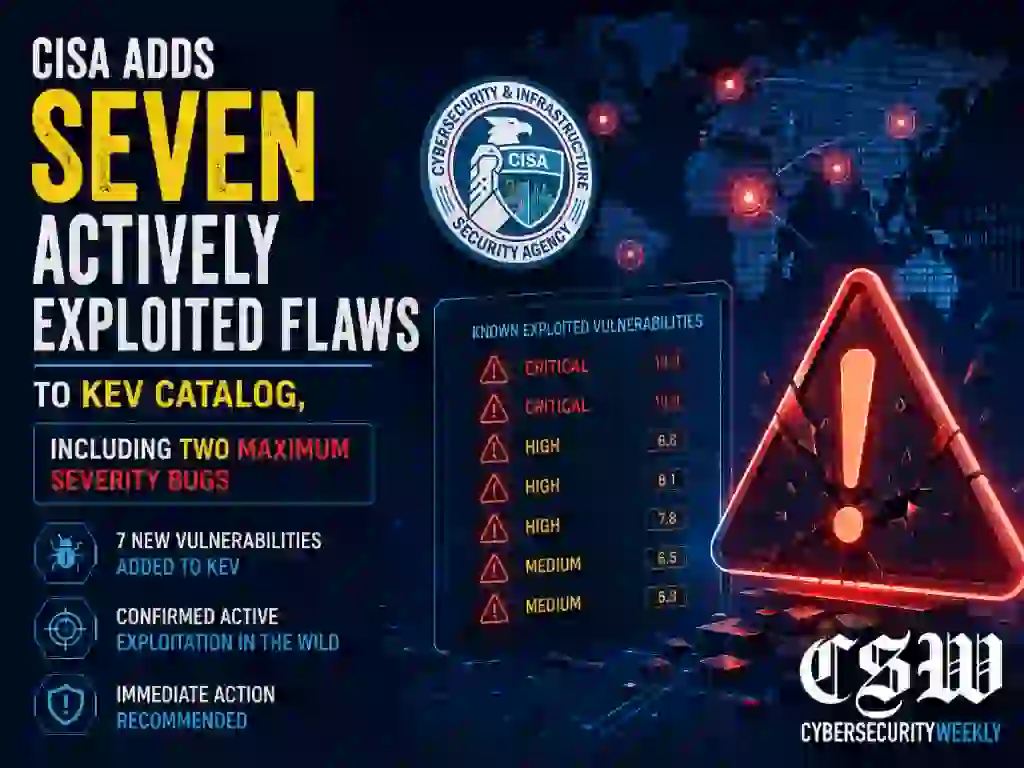
The Cybersecurity and Infrastructure Security Agency added seven vulnerabilities to its Known Exploited Vulnerabilities catalog on September 3, 2026, after confirming that attackers are actively using them in the wild. Two of the seven carry a maximum severity score of 10.0, and researchers have already tied several of the flaws to cryptocurrency mining and reverse shell deployments on compromised systems.
The catalog update covers products from SonicWall, Sangoma, JFrog, the Starlette Python framework, the workflow automation platform Kestra, and the LiteLLM proxy used to manage large language model API traffic. Federal civilian agencies now face binding deadlines to patch or disable the affected systems.
What was added
Two of the new entries affect SonicWall’s SMA 1000 series appliances. CVE-2026-83548, rated 10.0 on the CVSS scale, is a server-side request forgery flaw that lets an attacker reach sensitive internal functionality without authorization. CVE-2026-83549, rated 7.8, is a post-authentication OS command injection bug that allows arbitrary command execution once an attacker has some level of access.
Sangoma’s Switchvox unified communications platform is affected by CVE-2026-9586, a SQL injection vulnerability rated 9.3 that lets an attacker run arbitrary queries against the product’s PostgreSQL database.
JFrog Artifactory is on the list because of CVE-2026-82329, an improper authentication flaw rated 9.8 that grants unauthenticated attackers full administrative control over instances running with default configuration. This is not new to readers of this site: we reported on active exploitation of this same JFrog Artifactory flaw on September 1, 2026, just days after JFrog shipped a patch. Its inclusion in the KEV catalog now confirms what security researchers had already observed independently.
The Kludex Starlette framework carries CVE-2026-48710, rated 6.5, an HTTP request and response smuggling issue that can bypass authentication through manipulation of URL paths. Kestra OSS, an open-source workflow orchestration tool, has CVE-2026-49869, rated a full 10.0, an OS command injection flaw that lets an unauthenticated attacker create and run arbitrary workflows on the system.
The final entry is CVE-2026-59822 in Berri AI’s LiteLLM, rated 8.8. It stems from improper authentication on the product’s MCP Streamable HTTP endpoint, which allows an attacker to establish arbitrary Bearer token sessions and interact with the system as if they were a legitimate authenticated user.
How attackers are using these bugs
According to Microsoft’s security research team, attackers exploiting the Kestra flaw have been observed establishing a reverse shell on compromised hosts, mapping out the Docker container environment they landed in, taking steps to evade detection, deploying a cryptocurrency miner, and harvesting data from the system.
Separately, attackers targeting exposed LiteLLM systems have been harvesting API keys, model configuration details, and credentials for the AI providers connected to those systems. After that theft, the same attackers have installed XMRig cryptocurrency mining software and modified SSH keys on the compromised machines to maintain long-term access.
Security researchers at SonicWall, Horizon3.ai, watchTowr, and Wiz have also published technical detail confirming exploitation activity tied to the vulnerabilities in their respective areas of coverage.
Patch deadlines
Under CISA’s binding operational directive, federal civilian executive branch agencies must apply patches for five of the seven vulnerabilities, the SonicWall pair, the Sangoma flaw, the JFrog flaw, and the Kestra flaw, by September 5, 2026. The remaining two, affecting Starlette and LiteLLM, carry a slightly longer deadline of September 16, 2026.
These deadlines apply directly only to federal agencies, but CISA’s KEV catalog is widely treated as a practical priority list by private-sector security teams as well, since inclusion means a flaw is confirmed to be under real-world attack rather than merely theoretical. Organizations running any of the affected SonicWall, Sangoma, JFrog, Starlette, Kestra, or LiteLLM products are advised to check their versions against the vendors’ patched releases without waiting for a formal deadline.
Source: This report is based on original reporting by The Hacker News.

