

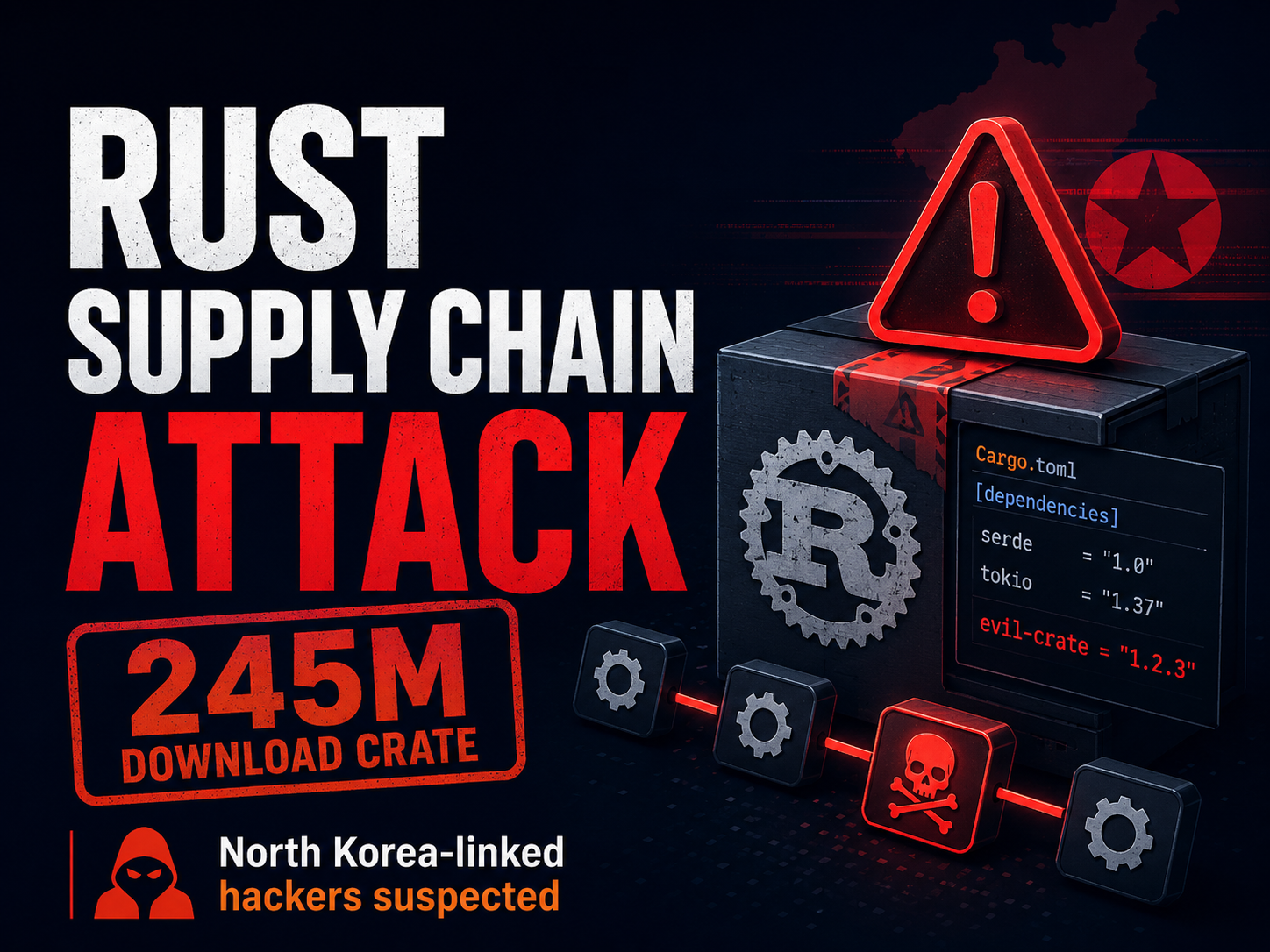
A supply chain attack hit the Rust programming ecosystem on August 20, 2026, when a threat actor used a compromised maintainer account to publish malicious versions of three popular open-source packages, known as crates. Security researchers say the infrastructure behind the attack overlaps with previous campaigns tied to North Korean hacking groups, though no cybersecurity vendor has issued a formal, on-the-record attribution to a specific named group.
The main target was arrayref, a small utility crate with more than 245 million all-time downloads that researchers say is used in roughly three-quarters of Rust build environments. Two smaller crates, internment and append-only-vec, were compromised in the same incident, published from what appears to be the same attacker infrastructure roughly twenty minutes later.
Rather than hiding malicious code inside the crates’ actual functionality, the attacker took a different approach. Each poisoned release added a single new dependency called proc-macro1, a name deliberately chosen to resemble proc-macro2, a legitimate and widely trusted crate. Because Rust automatically downloads and builds all of a project’s dependencies, simply adding this one dependency was enough to trigger the attack on any machine that compiled the affected packages, without requiring a developer to call any new function or write any new code.
The fake proc-macro1 crate contained a build script, a small program that Rust runs automatically during compilation, that reassembled a command-and-control server address from fragments encoded in base64 and disabled TLS certificate validation before reaching out to fetch a second-stage payload. On Windows systems, this arrived as a PowerShell script launched through a VBScript wrapper; on Linux and macOS, it was written to a temporary file. Once running, researchers say the malware could steal saved credentials from Chrome, Brave, and Edge browsers, and installed itself to survive a reboot using Registry Run keys on Windows, LaunchAgents on macOS, or a systemd service on Linux. It also accepted remote commands to reconfigure its command-and-control settings, run arbitrary scripts, or shut itself down.
The compromise was first spotted by researchers at Nextron Systems, who reported the malicious arrayref release around 07:15 UTC on August 20. The Rust Security Response Team acted quickly, removing all three malicious package versions from the crates.io registry between roughly 86 and 107 minutes after they first went live, and restoring clean versions in their place. The team said it found no evidence that the malicious versions had actually been downloaded and used by developers before removal, and added that it does not believe arrayref’s original maintainer acted maliciously, stating the maintainer’s computer or credentials were likely compromised by someone else.
Cybersecurity firm Wiz, which also investigated the incident, said the attack infrastructure showed what it called substantial infrastructure overlaps with earlier supply chain attacks against the JavaScript ecosystem, including prior compromises of the Axios and Mastra npm packages that researchers have previously linked to North Korean state-backed hacking activity. Wiz pointed to shared command-and-control endpoints, overlapping IP address ranges, and reuse of infrastructure hosted through Hostwinds LLC as the basis for the connection. As of publication, this remains an infrastructure-based assessment rather than a confirmed, named attribution.
The incident is a reminder that open-source package registries remain an attractive target for attackers precisely because a single compromised maintainer account can reach millions of downstream users through routine, automated dependency updates. Developers who installed arrayref, internment, or append-only-vec around August 20, 2026 may want to check their build logs and lockfiles for the poisoned versions and confirm they have since updated to the restored, clean releases.
Source: SecurityWeek, with additional reporting from The Hacker News.

